
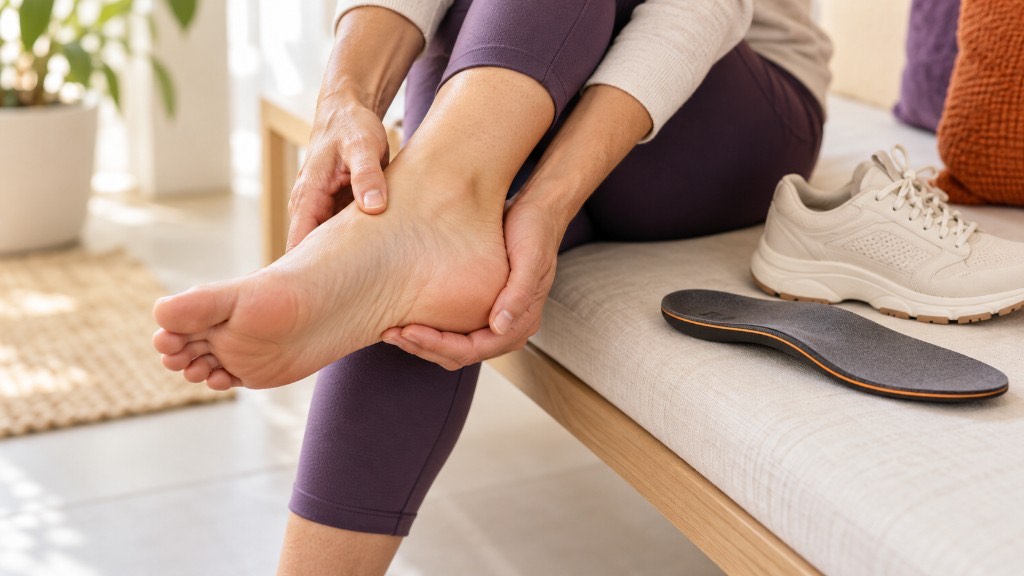
Plantar fasciitis concerns the plantar fascia beneath the foot, while a heel spur is a bony projection. Insoles may be considered within a broader care plan rather than as a guaranteed stand-alone solution.
Plantar fasciitis is a painful condition associated with the plantar fascia, the tissue extending beneath the foot from the heel towards the forefoot. Pain often occurs under the heel and may extend around the arch. Discomfort during the first steps out of bed is a familiar description. However, not every episode of first-step pain or heel tenderness has the same cause.
Plantar fasciitis and heel spurs are sometimes used interchangeably in everyday conversation. One refers to a clinical condition involving soft tissue, while the other describes a bony projection. Understanding the distinction helps make sense of imaging findings, footwear advice and the purpose of an insert.
The plantar fascia is a strong band of connective tissue beneath the sole, extending from the heel bone towards the forefoot. It is one of the structures supporting the arch and contributes to load-bearing during walking. Symptoms may develop in association with repeated loading and tissue strain.
Although the name plantar fasciitis is widely used, the condition should not be understood simply as inflammation alone. In persistent cases, the tissue's response to loading also matters. Management therefore considers everyday demands and function rather than focusing only on temporary symptom relief.
A heel spur is a projection from the heel bone that can be visible on imaging. It may occur alongside plantar fasciitis, but a spur is not required for plantar fasciitis to be present. Some people with heel spurs have no heel pain.
| Comparison | Plantar fasciitis | Heel spur |
|---|---|---|
| What does it describe? | A painful clinical condition associated with the plantar fascia. | A bony projection from the heel. |
| How is it assessed? | Symptoms and examination are central; imaging may be added where indicated. | The projection may be visible on an X-ray. |
| Relationship to pain | Can cause pain beneath the heel and around the arch. | Its presence alone does not establish the source of pain. |
| Aim of an insert | To contribute to support and load management where appropriate. | Not to dissolve the spur or remove bone. |
Seeing the words heel spur in a report does not mean every symptom should be attributed to that finding. The goal is not simply to change the appearance of an X-ray. The cause of pain and its effect on everyday movement need consideration together. For product-focused assessment, see our guide to insoles for heel spurs.
Pain beneath the heel may be prominent during the first steps after sleep or rest. It may ease with some movement and return after prolonged standing or walking. The precise location, daily pattern and timing of onset help guide the assessment.
A recent increase in walking or running, a change to exercise on hard surfaces or inadequate footwear support may be relevant. None of these factors confirms the diagnosis alone. Numbness, marked swelling or an injury history are reasons to consider other possible causes as well. For broader heel symptoms, see our guide to heel pain.
A clinician asks about the onset of pain, its relationship to rest and the demands of work and sport, then examines the foot and ankle. Tenderness beneath the heel and movement characteristics are considered. The aim is both to assess for plantar fasciitis and to distinguish other conditions that can cause similar symptoms.
Not everyone needs the same imaging. X-rays, ultrasound or MRI are selected according to the examination and suspected problem. Foot pressure measurement may provide additional information about loading across the sole, but it cannot independently confirm plantar fasciitis or exclude other conditions.
For selected people, insoles may be planned to support the foot and help manage loading. They should not be presented as an isolated short-term pain treatment for plantar fasciitis. Considering them alongside exercise, activity modification and footwear advice is important.
Choosing between prefabricated and custom-made options should begin with the need being addressed rather than the product name. Custom orthotics are not compulsory for everyone. A more expensive or firmer device is not automatically more suitable, and a heel pad, arch support and full-length insert do not perform identical roles.
Useful questions include: What is this device intended to achieve? How will we try it with my shoes? What should prompt a review? An insert should not be described as dissolving a heel spur, immediately removing all pain or guaranteeing that no other treatment will be needed. For inner arch and support contact, see our article on foot arch pain.
Shoes should avoid squeezing the foot, hold the heel securely and provide appropriate cushioning. Putting a new insert into markedly worn footwear will not necessarily solve every problem. Trials should include the socks and support that will actually be used.
Check whether the toes still have room, whether the heel slips and whether there is focal pressure beneath the arch. Ask whether the shoe's original liner needs removal. Avoid narrowing the available space by independently stacking multiple pads.
The amount of provoking activity may need temporary reduction, with movement planned around the individual situation. Increasing running distance through pain or immediately returning to the full previous load as soon as symptoms settle may be inappropriate. Professional guidance on exercise selection and progression is particularly useful when symptoms persist.
If an insert is supplied, increase use according to the recommended plan. A mild change in contact is different from sharp pain, numbness or skin damage. Stop using the device and have its fit checked if significant problems develop. Do not cut, heat or bend it yourself.
Keep notes on first-step pain, daily walking tolerance and the footwear used. Follow-up should consider everyday function and symptoms after activity, rather than only whether an insert feels comfortable initially. A single recovery deadline or daily wearing time cannot be prescribed for everyone. For breaking in and care, see our guide on how to use insoles.
Arrange medical assessment if pain interferes with ordinary activities, keeps returning, gets worse or fails to improve with simple measures. Do not delay advice about foot pain in someone with diabetes, numbness, reduced sensation or wounds. Avoid diagnosing every painful heel as plantar fasciitis from an online description.
Inability to bear weight, a clear change in shape or severe pain after an injury requires prompt medical attention. A useful approach combines appropriate assessment, an understanding of the difference from heel spurs and consideration of footwear and support within a broader care plan. You can arrange a discussion suited to your needs.