
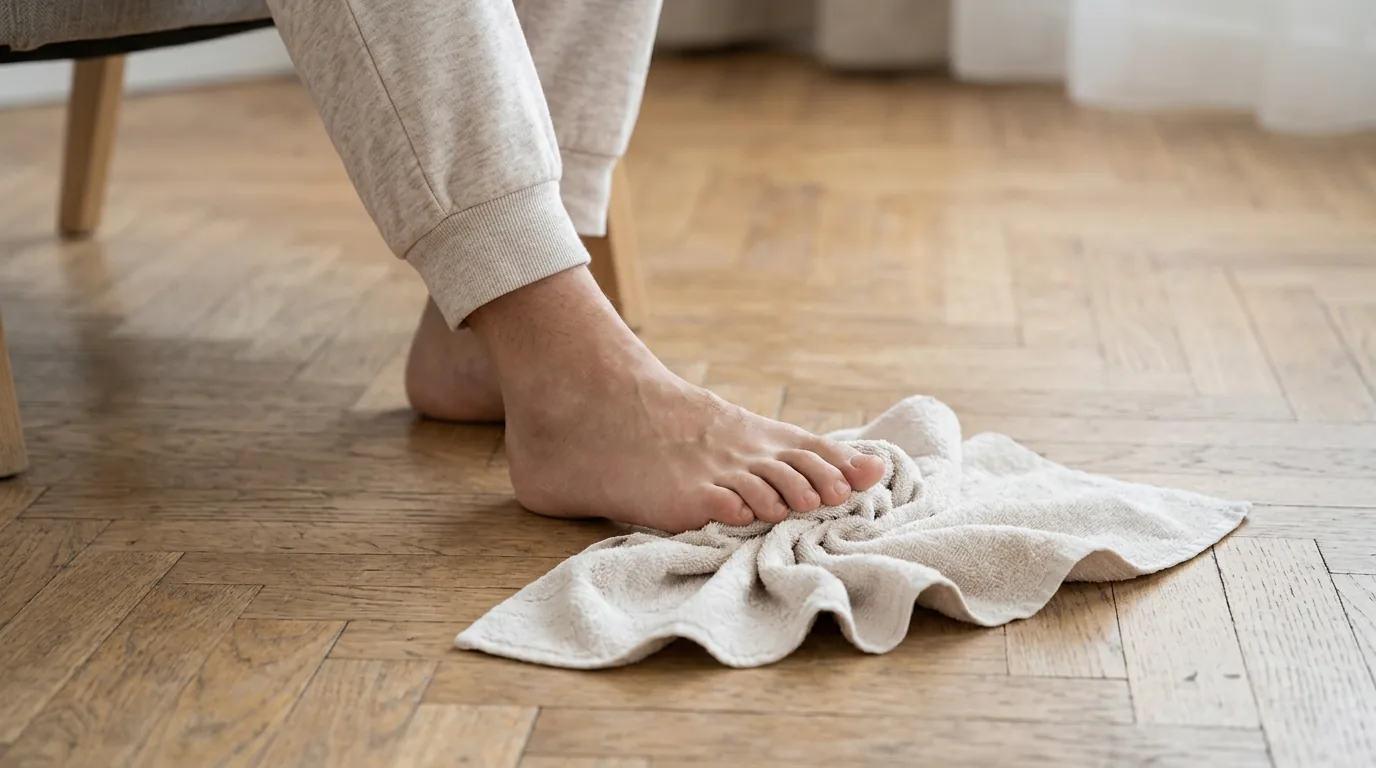
Five flat feet exercises you can do at home, what research says about them and when to see a specialist.
Flat feet exercises are simple movements that work the small muscles in the sole of the foot and the calf. The short foot exercise, towel scrunches, toe spreading, heel raises and calf stretches can all be done at home. These exercises do not change the shape of the foot; for symptoms such as pain or stiffness they can be part of a plan recommended by a specialist. [1]
Flat feet (pes planus) means the arch on the inner side of the foot is not visible when standing, so most of the sole touches the ground. It is common and often causes no problems. Most young children's feet look flat; the arch usually develops between the ages of 3 and 10. [1]
Flat feet that do not cause pain or other symptoms do not need any treatment. Flat feet also do not stop you from doing everyday activities, including sport. [1] To check at home whether your foot has an arch, see our flat feet test article; for children, see flat feet in children.
The most studied exercise for flat feet is the short foot exercise. A meta-analysis combining six randomised studies (201 participants) found small improvements in two measures used to assess the arch (navicular drop and the Foot Posture Index) in the groups that did this exercise; there was no difference between groups in muscle size. [3] A review of nine studies found that four of the six studies that measured the arch reported an improvement; improvements were seen with programmes of at least 5 weeks, but there was no shared recommendation on how many repetitions or how often. [4]
Another analysis of studies on strengthening the small muscles of the foot found improvements in measures of balance, strength and everyday function; for reducing pain, these exercises were not better than the methods they were compared with. [5] These results show that measurements can change; they do not guarantee the same result for everyone or a lasting change in the shape of the foot.
Do the movements slowly and with control, within a pain-free range. Because studies do not agree on the number of repetitions or how often, start with a few repetitions. [4] If a physiotherapist or doctor has given you a programme, follow their advice.
Aim: To work the small muscles in the sole of the foot in a way that supports the arch. [3]
When you can do the movement comfortably sitting down, you can try it standing.
Aim: To work the muscles that bend the toes.
Aim: To use the small muscles of the foot with control.
Aim: To work the calf muscles.
If your balance is poor or the movement hurts, do not do this exercise without asking a specialist.
Aim: To stretch the calf and the heel cord (Achilles tendon). [2]
If a movement makes your pain worse, stop doing it. See a doctor if you have flat feet and any of the following: [1]
For people with symptoms, a foot specialist may give advice on exercises together with footwear, insoles and, if needed, painkillers. Wide, comfortable shoes with a low heel are usually suitable. These approaches do not change the shape of the foot; they can help with symptoms such as pain and stiffness. [1]
Whether you need an insole, and which type suits you, depends on the person. What to look for when choosing one is covered in our insoles for flat feet article, and information on foot assessment is on our foot health page. If the sole of your foot hurts, our sole of foot pain article explains possible causes.
Exercises do not change the shape of the foot. [1] Studies on the short foot exercise reported small improvements in arch measurements; this does not mean the flat feet will go away. [3]
There is no fixed time for everyone. In the reviewed studies, arch-related improvements were seen with programmes of at least 5 weeks. [4]
In most children the arch develops between the ages of 3 and 10, and if there are no symptoms nothing needs to be done. [1] If there is pain or tiredness, a doctor may recommend movements such as a heel cord stretch. [2]
Flat feet on their own do not stop you from doing activities, including sport. [1] If running causes pain, talk to a specialist.
This article is for general information and does not replace diagnosis or treatment. If you have pain, talk to a specialist before starting exercises.
Sources reviewed on 22 November 2026.