
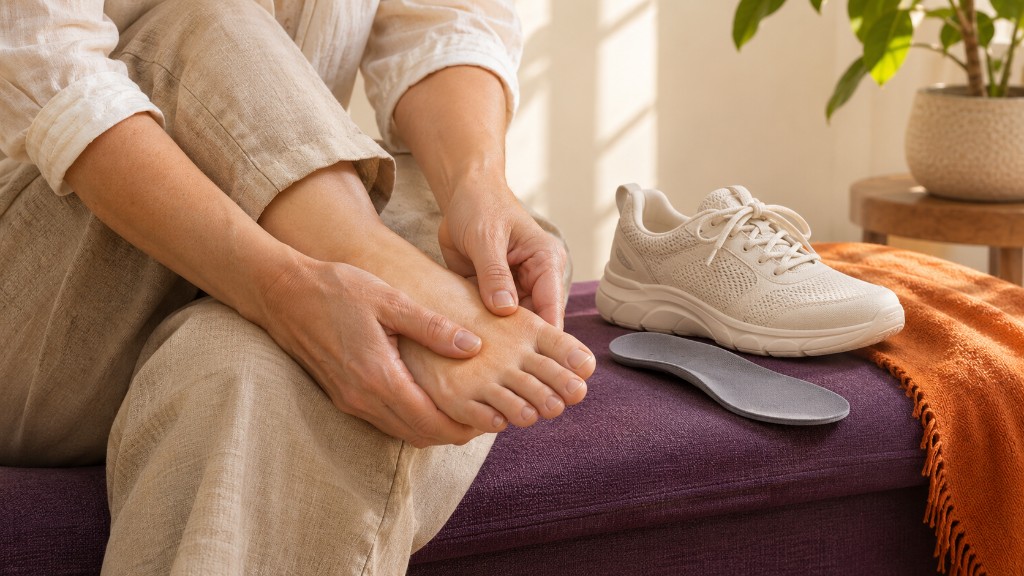
A pebble-like feeling beneath the forefoot and burning into the toes can occur with Morton's neuroma. Footwear space, daily loading and support fit should be considered together.
Morton's neuroma involves irritation of a small nerve leading to the toes and thickening of the tissue around it. It most commonly affects the space between the third and fourth toes. People may describe burning, numbness or the feeling of a small pebble inside the shoe. Despite its name, it is not a true nerve tumour.
Understanding the problem involves more than identifying a painful spot. The shoes worn when symptoms begin, the effect of walking and whether discomfort travels into the toes all matter. Footwear changes and insoles may form part of a management plan after assessment. Burning feet should not automatically lead to buying the same support for everyone.
Symptoms may include sharp forefoot discomfort, tingling or an electric sensation extending towards the toes. Some people check their socks for a fold or search the shoe for a small object without finding anything. The absence of a visible lump does not explain away persistent discomfort.
Narrow footwear and activities that load the forefoot may make symptoms more noticeable. However, this pattern cannot confirm the diagnosis at home. Keeping a short record of which toes are affected and how long symptoms last can make a clinical discussion clearer. Repeated numbness deserves attention even when removing a shoe seems to provide relief.
Metatarsalgia describes pain in the ball of the foot rather than one specific diagnosis. Morton's neuroma is a particular nerve-related problem in that region. Calluses, joint problems and stress injuries can also cause forefoot pain. Conditions such as hallux valgus may also change forefoot loading and shoe contact. An earlier description of metatarsalgia does not automatically explain a new burning sensation.
| Point to discuss | Why it matters |
|---|---|
| Location and spread into the toes | Describes the distribution of symptoms. |
| Numbness or electric sensations | Raises questions about nerve involvement. |
| Links with footwear and activity | Helps identify circumstances that aggravate discomfort. |
| Injury, swelling or skin changes | May require investigation of other causes. |
These observations support a consultation; they are not a diagnostic checklist. Distinguishing between possible conditions requires clinical judgement rather than matching one symptom to an online description.
The front of the shoe is particularly relevant when assessing Morton's neuroma. A narrow toe box can compress the forefoot, while high heels increase loading towards the front of the foot. A comfortable shoe with a wider toe box and a lower heel may be considered. A label such as “orthopaedic” does not establish that a particular model fits you. Practical points on everyday footwear fit are also covered in our guide to foot fatigue, shoes and insoles.
Check more than the length. Consider space across the toes, pressure from the upper and whether the fastening holds your foot comfortably. Choosing a longer size solely to gain width may introduce unwanted movement. The practical aim is to find an appropriate shape and fit, rather than relying on a size number alone.
Try footwear with the socks and any insoles you expect to use. Walk a short distance and notice whether pressure develops across the forefoot. A shoe that feels roomy without an insert may become restrictive once one is added. If the upper starts pressing on the toes, the shoe and support need to be reconsidered together.
Metatarsal pads and suitable insoles may be considered to redistribute forefoot loading and reduce pressure around a sensitive area. Softness alone does not determine suitability. Shape, height, position inside the shoe and the person's response all matter. Suspected Morton's neuroma does not mean that everyone requires a custom-made orthosis.
Discuss pad placement with a qualified professional rather than repeatedly adding products at random. If a new support increases burning or numbness, stop using it and have the fit checked. Increasing symptoms should not be treated as something you must tolerate during an adjustment period. An online photograph cannot determine the correct measurements or placement for every foot.
An insole should not be presented as removing the nerve problem or guaranteeing that tissue thickening will disappear. Its role is to help manage loading where appropriate. The choice between a ready-made support and a custom option should reflect assessment findings, footwear space, intended activities and the response to previous trials. Differences between ready-made and custom options are summarised in our orthopedic insoles guide.
When running, jumping or long walks aggravate symptoms, temporarily reducing the provoking activity may be appropriate. This does not mean prescribing the same period of rest for everyone. Work responsibilities, movement needs and symptom behaviour should inform the discussion. A healthcare professional can help decide what adjustment is suitable for your circumstances.
Think about the shoes used for the largest part of your day. A comfortable trainer worn briefly may not address pressure from work footwear worn for many hours. Recording the model, activity and point at which discomfort begins helps turn a vague description of “uncomfortable shoes” into information that can guide a fitting discussion.
Assessment of Morton's neuroma starts with the symptom history and a clinical examination. A clinician may request ultrasound or another investigation where necessary; an MRI is not required for every person. Repeatedly squeezing the forefoot at home to reproduce pain is not a reliable way to establish the diagnosis.
A foot-pressure assessment can provide additional information about loading when planning support. It does not image the nerve and cannot diagnose Morton's neuroma on its own. Colours on a pressure map cannot establish the size of a nerve problem or identify a guaranteed treatment. Clarifying the clinical issue and evaluating the fit of a support are related but distinct tasks.
Arrange assessment for recurring, worsening or activity-limiting pain. Tingling, numbness or weakness should not be ignored. Symptoms that do not improve after around two weeks of simple adjustments also warrant review; significant symptoms do not require waiting for that period to pass. Inability to bear weight after an injury or a hot, red and swollen foot needs more prompt attention.
If footwear and support changes do not provide adequate relief, a clinician can discuss further treatment options. Decisions about injections or surgery require an individual assessment of benefits and risks. An insole consultation should not delay medical investigation when it is needed.
Bring the footwear you use most often, your existing insoles and a brief symptom record. Explain where discomfort begins, whether it spreads into the toes and how it changes during work or sport. This makes it easier to assess how footwear and support fit your daily needs, rather than choosing a new product in isolation. To discuss insole options, you can arrange a consultation suited to your needs.