
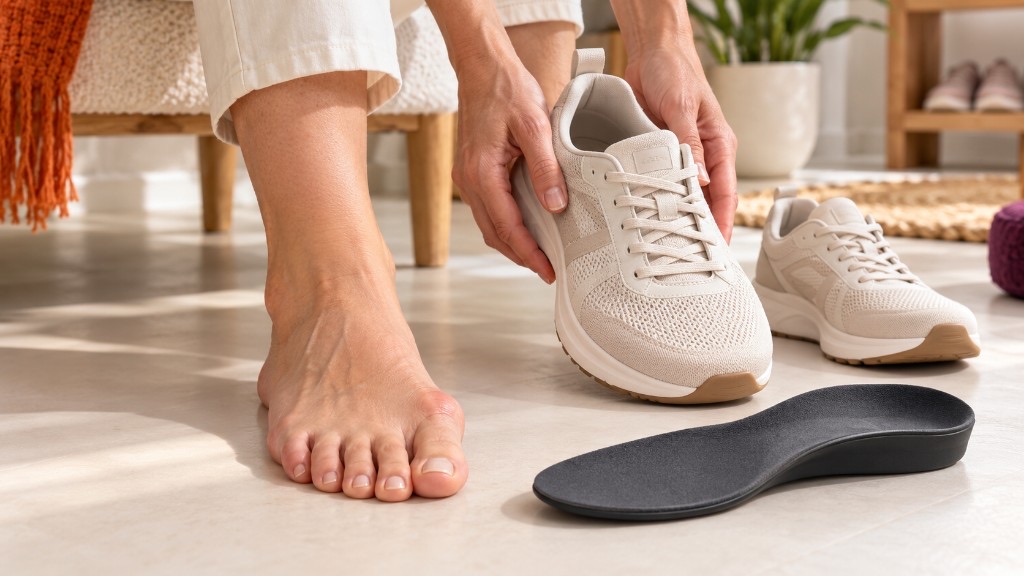
Shoe contact around the big toe and comfort during everyday movement matter in hallux valgus. Learn about the different purposes and limits of footwear, protective supports and insoles.
Hallux valgus is a change in alignment in which the big toe points towards the smaller toes and a prominence may develop on the inner side of its base joint. It can cause shoe irritation, pain or difficulty walking, although symptoms vary.
Suitable footwear and some supports may improve comfort. The purpose of an insole should be identified for the individual; it should not be presented as a permanent correction of bone alignment.
Hallux valgus describes the big toe angling towards its neighbours. The prominence on the inner side of the joint at the base of the big toe is commonly called a bunion. Shoe contact can make that area tender.
Size alone does not determine the severity of symptoms or the need for treatment. The ability to wear footwear, walk and take part in everyday activities also matters.
Family predisposition, foot structure and some joint conditions can play a role. Tight or poorly fitting footwear can increase pressure and existing discomfort. A single cause cannot be identified for everyone.
It is therefore insufficient to explain every case as the result of wearing the wrong shoes. Mention whether similar changes run in the family and when you first noticed the problem.
Pain or swelling around the big toe joint, redness from shoe contact and crowding between toes may occur. Some people also describe discomfort or calluses under the forefoot. Others have little or no pain despite a noticeable change in appearance. For recurring hardened skin or friction under the forefoot, see our guide to foot corns and calluses.
Do not automatically attribute a newly hot, swollen and very painful joint to hallux valgus. Gout, inflammatory conditions or an injury may need to be distinguished.
Look for a sufficiently wide and deep toe box that does not compress the big toe area. A soft upper may reduce pressure over the prominence. High heels and narrow, pointed footwear may aggravate symptoms.
| Feature to check | A question during fitting |
|---|---|
| Toe-box width | Are the big toe and adjacent toes compressed from the sides? |
| Toe-box depth | Is there pressure over the toes or prominence? |
| Upper and seams | Does a firm edge touch the tender area? |
| Heel hold | Does the foot slide forwards inside the shoe? |
| Fit with a support | Does adding a pad or insole make the shoe tighter? |
Consider a shoe shape suited to the foot rather than simply buying a larger size. Try the footwear while standing and walking briefly; do not rely on a tight shoe eventually stretching to fit.
Protective pads may reduce rubbing from footwear, while toe spacers may help ease contact between neighbouring toes. An insole is a different tool that can address support and loading beneath the foot.
These products are not automatically interchangeable. Combining several inside an already tight shoe may increase pressure. A “corrector” label does not establish that a device permanently changes the deformity. You can review the general differences between ready-made and custom options in our guide to orthopedic insoles.
Following assessment, an insole may be considered in relation to accompanying foot structure, forefoot symptoms or loading needs. The aim may be to relieve a particular area or support walking comfort. It is not essential for every person with hallux valgus.
A prefabricated support may suit some people, while others may need individual adaptations. Selection should reflect the target symptom and footwear fit rather than price or a product name.
Ask which problem the recommendation addresses, why a ready-made option is suitable or insufficient and how benefit will be reviewed. Insoles do not permanently reverse an established bony deformity. After a recommendation, our guide to how to use insoles covers fitting and adaptation.
Where appropriate, pressure measurement can help examine loading across areas of the sole in contact with the ground. It should be interpreted alongside examination, symptoms and observation of walking.
A pressure map does not measure the bony angles of hallux valgus or independently determine a diagnosis or surgical decision. A clinician may request investigations such as weight-bearing X-rays when needed. Pressure analysis is not mandatory for everyone.
Speak with an orthopaedic clinician if pain persists despite footwear changes, daily walking becomes difficult or the deformity is worsening. An assessment by a foot and ankle specialist may be appropriate.
With diabetes, impaired circulation or reduced sensation, obtain professional advice before trying a new device. Do not delay assessment of a new wound, discharge or suspected infection. New severe pain with marked redness and warmth also needs prompt assessment.
No. Appearance alone does not determine a need for surgery when the foot is painless or daily life is unaffected. Footwear adjustments and suitable supports may help some people manage their symptoms.
Surgical options may be discussed if pain and functional limitations persist despite nonsurgical care. The procedure and its appropriateness depend on the individual; no single product can guarantee that surgery will never be needed.
Assess a footwear change or support against a particular daily activity. What changed at the end of a working day, during the same walk or while wearing a specific shoe? Note the footwear and location of discomfort.
Do not push through new pressure, skin irritation or increasing pain. Bring the footwear, support and notes to review. Everyday comfort and function matter, rather than appearance alone.