
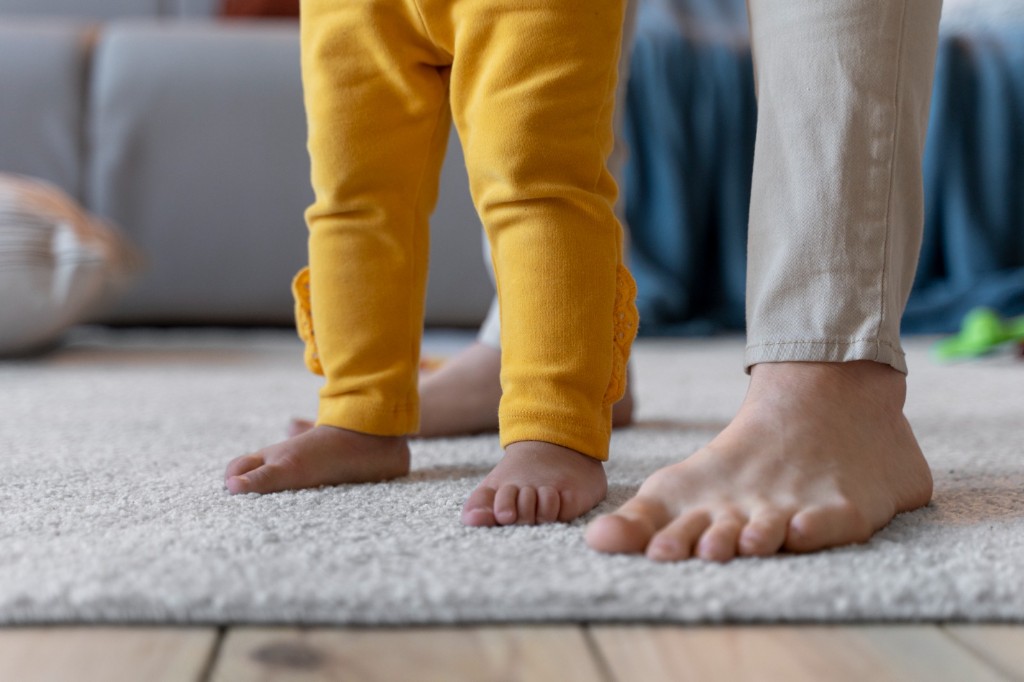
Low arches in children do not always require treatment. Learn how symptoms, flexibility and everyday movement guide assessment, and what insoles may be intended to achieve.
Flat feet in children are common, particularly at younger ages; painless, flexible feet usually do not need insoles or other treatment. Pain, stiffness or difficulty walking and running should prompt a medical assessment.
An insole decision should consider more than how much of the foot touches the ground. Symptoms, examination findings and participation in everyday activities matter together.
Flat feet describe an arch on the inside of the foot that appears low or is difficult to see when standing. In young children, this can be part of development. Some arches become more visible with growth; some feet retain a low-arched shape.
Appearance and comfortable movement are different considerations. A child who walks, runs and plays without pain does not necessarily have a problem simply because their arches are low.
With flexible flat feet, an arch that flattens when standing may reappear when sitting or rising onto tiptoes. With rigid flat feet, this change may be absent and movement may be restricted.
This distinction belongs within an examination. A movement observed at home or a photograph does not establish a diagnosis. Stiff-looking feet or a marked difference between the two feet are reasons to speak with a doctor before buying insoles.
Arches can change throughout childhood. Children do not all develop the same foot shape at the same age, and a particular birthday is not a deadline for starting insoles.
For parents, “Is my child moving comfortably?” is as useful a question as “Is the arch more visible?” At an appointment, describe changes in walking or play as well as the appearance of the feet.
Speak with your child's doctor or an orthopaedic clinician about the following concerns. A paediatric orthopaedic assessment may be arranged when appropriate.
| Observation | What to discuss during assessment |
|---|---|
| Recurring foot pain | Location, onset and relationship to activity |
| Difficulty running or jumping | How everyday movement is affected |
| Stiff-looking feet | Joint movement and flexibility |
| A marked difference between the feet | The reason for asymmetry |
| Tenderness in a particular area | The source of pain and whether further investigation is needed |
Do not assume that flat feet explain every episode of pain. A doctor may investigate other causes. Bringing frequently worn shoes and noting which activity triggers symptoms can help make the discussion more specific.
The clinician discusses symptoms and medical history and examines the feet and legs. Posture, walking, joint movement and Achilles tendon tightness may be checked. Not every child needs an X-ray or another scan; the clinician decides whether further investigation is appropriate.
If foot scanning or pressure analysis is proposed, ask what question it is intended to answer. A measurement report does not by itself establish a need for insoles; results should be interpreted alongside symptoms and clinical findings.
Routine insoles solely to prevent future problems are not supported for otherwise healthy children with painless, flexible flat feet. The Cochrane review found no supporting evidence for expensive custom orthoses in this group; certainty in the available research was also low.
For a child with symptoms, an appropriate support may be considered after assessment to improve comfort. Insoles should not be presented as a way to permanently create an arch or guarantee the same outcome for every child.
Ask: “Which symptom are we targeting?”, “How will we judge benefit?” and “When should we arrange a review?” Understand the purpose of the recommendation before purchasing.
Custom-made insoles are not automatically the first or necessary choice for every child. Prefabricated supports may also be considered in some symptomatic flexible flat feet; custom supports should not be assumed to be superior for everyone.
If a custom product is recommended, ask why it was selected, why a ready-made option was considered unsuitable, and which shoes it will be used in. The explanation should relate to your child rather than rely on a product name or price.
Shoes should fit the foot, avoid crowding the toes and hold the foot securely. Adjustable fastenings such as laces or hook-and-loop straps can help with fit. Do not base the decision solely on an “orthopaedic” label.
Children with painless, flexible flat feet do not need to avoid sport simply because of their foot shape. Activity plans may change when symptoms occur. Stretching or strengthening should address an identified need rather than follow the same programme for every child.
Clarify wearing time and the introduction plan with the prescribing clinician. Fit should be checked as feet grow, footwear changes or insoles wear out. Returning symptoms are another reason to request a review.
Describe your child's experience as well as the condition of the product: are school, walks and play more comfortable? Report persistent discomfort and ask for the recommendation to be reassessed if there is no benefit.